From the Wild West to Here to Stay: A Q&A with etvolare
Written by: Cosyjuhye
When I started conceptualizing Translator Spotlight, a new series featuring the translators behind Wuxiaworld’s novels, it took me less than five minutes to decide who the first guest should be.Etvolare—or etvo, as many fans affectionately call her—felt like my obvious pick. On a personal note, she also played a special role in how I first entered the webnovel scene. I started from Volare, so… if you know, you know. But that is a story for another day.
This series is about the people behind the chapters.. After all, translators do more than translate words from one language to another. They shape how English-speaking readers meet a story: the tone, rhythm, jokes, titles, cultural references, fight-scene pacing, descriptions, and all the little choices that decide how a chapter will look like.
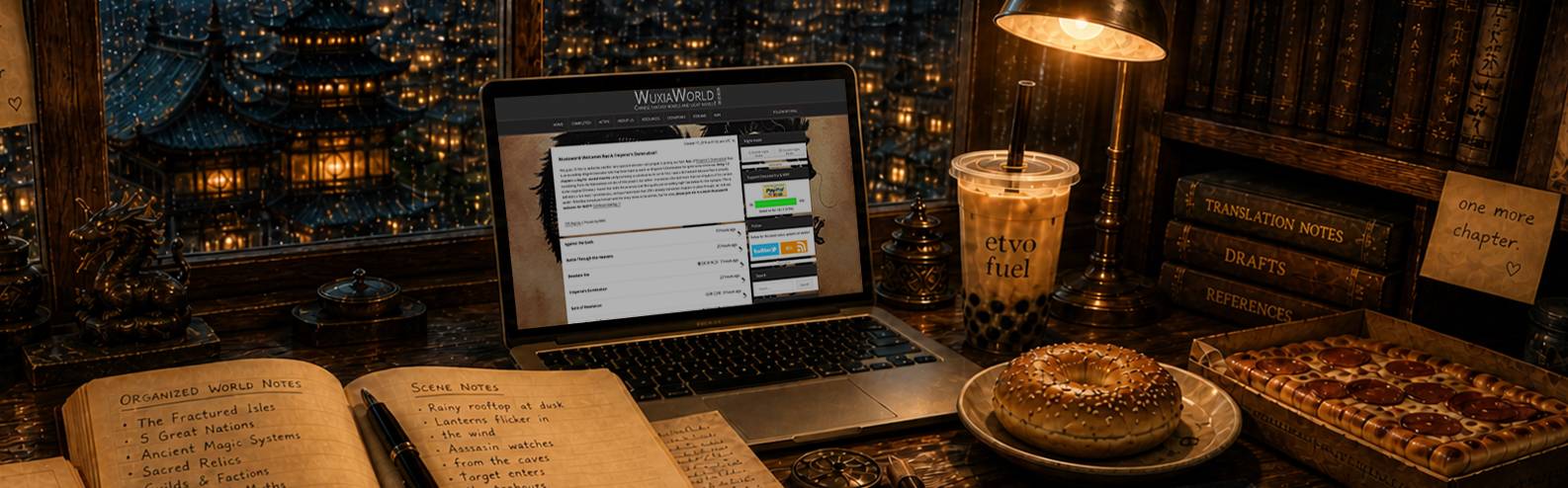
etvo has been in the scene since the much earlier days, back when Wuxiaworld still had that black dragon on a parchment-style header. Across works like Sovereign of the Three Realms, Great Demon King, Necropolis Immortal, Return of the Swallow, Doomed to be Cannon Fodder, and Star Gate, she has watched webnovel translation grow from scattered fan-translation culture into a far more mature industry.
So for our first Translator Spotlight, we’re going down memory lane with etvo—all the way back to what she calls the “wild west” days.
You’ve now spent around a decade in the webnovel translation scene. When you look back, what feels most different about the space compared to when you first started?
etvolare:
I think I’d definitely have to point to the innate differences between a mature industry and a burgeoning scene. It was truly the wild west when we first started.
Translations were scattered all over the place, some on forums, others on sites, some on password-locked blogs, and some in chat groups. Novel Updates was a critical resource for rounding all of it together and keeping track of updates. So much was happening all the time.
Now we have significant publisher presence in the scene and everything is much more standardized. Gone are the days in which translators also had to figure out coding their own sites. I had to hand format HTML for every single chapter page. We just load our chapters in, write a thought or two, and off we go.
Authorization and monetization are also much more defined now. Everyone operates in a much clearer framework.
Vibrant Comment Sections
What did webnovel translation feel like in the earlier days that newer readers or translators might not immediately understand now?
etvolare:
Everything was so fresh and new, which meant a lot of fun and uncertainty. There were so many translation choices to choose from since anything and everything was possible. Something new seemed to be happening every day.
A lot of discussion happened in the comments as this was pre-Discord and advance chapter availability. Thoughts, speculation, and even individual chapter reaction threads would come out regularly on the r/noveltranslations subreddit.
The community was so vibrant then. So much discussion happened everywhere and readers interacted heavily with each other and us. It really felt like a community effort and there was definitely a sense of comradery.
The uncertainty was also a defining characteristic. Since monetization was not nearly as robust as it is now, translation in the early days was very much a hobby. Translators would drop off for vacation, exams, sickness, or just outright vanish when they burned out. Updates three times a week was a very respectable pace.
I remember when translation started shifting to being more of a job and the pace gradually moved toward two chapters a day, seven days a week. Oh how we (I) hated that. It meant working every day without breaks, or doing double the workload if we wanted a weekend or vacation.
Piracy was also such a thorn in our side. I spent a good portion of the day DMCA’ing pirates and even wrote hidden white-text warnings into chapters: “This chapter has been stolen from etvolare, the translator…”
The Readers Got Sharper and Kinder
In your view, how has readership evolved over the years? Have readers changed in what they expect, notice, or respond to?
etvolare:
I think the readership has gotten much more discerning over the years, and they’ve gotten nicer! :)
After ten years of reading the same-old face-slapping, people want a twist on the usual or something different entirely. As opposed to the quick level-ups or breakthroughs that people might have relished in the early days, they now look for solid characterization and good plot development.
Plot holes and xianxia math don’t seem to fly as much anymore. I see readers actively tracking inconsistencies and relating the sometimes ludicrous sizes or amounts in our novels to what they’d actually look like in real life.
And for some reason, I feel that readers have gotten much nicer over the years. I remember translators getting flamed in the early days, or readers fighting with each other in the comments. Man, did those insults fly.
The Long Game Behind Every Chapter
You’ve mentioned that in the early years, translation involved a lot of learning alongside the work itself. How has your process changed since then? Are there parts of translation that used to feel difficult or slow that now feel much more instinctive?
etvolare:
I definitely don’t have to translate with a dictionary next to me anymore, heh! Thankfully, my Chinese has vastly improved from it.
I think I’ve fallen into a groove of first runthrough: the actual translation. Second runthrough: translation checking. Third runthrough: rewriting for flow.
These days, I strive to read more English novels to update my writing style. It’s easy to fall into a rut and rely on the same turns of phrase, much like Chinese authors can get into the habit of doing. I’m always on the lookout for how I might better convey the atmosphere and meaning that the original text sought to convey.
I especially struggled before with knowing when I could deviate from the raws. I used to be a very literal translator in the sense of faithfully reproducing everything the author wrote, even the fifth reaction for the same scene.
These days, I know much more when something actually adds to a scene and if something works out flow-wise for English reading conventions.
New Tools, But Human Touch Is Still the Way
With AI-assisted tools becoming more common, are there parts of the process where you find them genuinely useful, and parts where you feel human judgment, tone, and instinct still make all the difference?
etvolare:
I wish AI was a lot more useful than it actually is. Currently, it hallucinates far too much and is so formulaic. Right now, it seems to look great and nice on the surface, but it quickly falls apart upon further observation.
I’ve tried using it in simple research and information gathering, but even there, it frequently pulls wrong information. So much time is needed to check and verify the work that honestly, it’s much easier to do it entirely myself. I do find it useful to research singular phrases or give me references where I can read a myth or belief system in more detail.
But when it comes to writing, thinking of new names, and rendering a scene with the same flair that the author intended, it has to be the human touch all the way.
What Veteran etvo Knows Now
Looking back, what do you think veteran etvo does now that early etvo had not yet fully learned?
etvolare:Early etvo definitely didn’t quite get the sense of how much of a marathon these novels are. Taking one on means locking oneself in for three years at minimum, four years on average. That’s years of daily publishing, twice a day, with no breaks unless one forces a pause in the schedule.
It doesn’t sound too hard at first, but it adds up. There’s a reason why we described translating as “digging ditches” in the early days!
It was also hard not to take things too personally in the past. If I was really proud of how I wrote a chapter or loved a certain development, but others were much less enthusiastic or even downright trashed it, it hurt deeply, lol. It would dim my enthusiasm for translating in the worst cases.
Now, it’s much easier to shake off and think of it as just different preferences.
A Career Told Through Titles
Across works like Sovereign of the Three Realms, Necropolis Immortal, Star Gate, Return of the Swallow, and Doomed to be Cannon Fodder, do you feel different titles mark different chapters of your growth as a translator?
etvolare:Absolutely. Sovereign of the Three Realms was my first foray into the scene, and it shows. It’s a typical long-form xianxia with many of the standard tropes. But if I were to pick any of my works to recommend, I would definitely point to SOTR. I distinctly remember thinking, “Anything less than 2,000 chapters is for wusses! I’m a real woman and I’m going to pick something at least that long!”
Lol. Geez.
After four years of SOTR, I wanted something less cliché and filler-y, so I picked Necropolis Immortal. NECRO is definitely no-holds-barred, full speed ahead all day every day. I definitely missed filler at one point and appreciated its function to aid mental digestion.
Doomed to be Cannon Fodder and Return of the Swallow took place concurrently with my other novels. DCF was my first major group project and the reason why I swore off translating like that forever. I oversaw seven or eight translators, TLC’d their work, and consolidated everything into one coherent whole. I was incredibly exhausted by the end of it and would probably just translate it myself, lol. It was such a fun story though.
I just really liked Return of the Swallow and wanted something different from all the xianxia I was translating. My writing skills received the most workout there, and I’m very proud of how I rendered the ornate scenes of palaces, clothes, and imperial titles. It was also lauded by graduates of translation master’s programs, and I was very chuffed to receive that recognition.
The One Closest to Her Heart
Which of your works feels the most personally special to you, and why?
etvolare:I will always point to Return of the Swallow. I may be the first translator to ever be written into the works she’s translating. I had a cameo in Necropolis Immortal and was the second female lead in Return of the Swallow. I asked the author on a whim if she could give me a cameo in the next arc and was incredibly honored that my character ended up as the second female lead instead.
I was also greatly saddened by its reception in the English world. It’s a court/family drama with a very heavy dose of political scheming and war strategy. As lovers of the genre would know, horrible family elders, green tea biatch sisters, and conniving frenemies are par for the course. The female lead always suffers a ton before delivering the most satisfying face-slapping.
Unfortunately, not every English reader received those conventions the same way. I feel that greatly contributed to its eventual lack of viability as a project.
The Hardest Story to Translate
Which project challenged you the most as a translator?
etvolare:Necropolis Immortal. The cultivation system pulled heavily from feng shui, Taoism, and Buddhism. I’ve lost track of the number of days I spent an entire afternoon researching what a string of 20 characters meant, then rendering them in English. It was a lot of unknown subject fields for me, ones hard enough to understand in Chinese already, not to mention translating them with the same flair and oomph in English.
What Makes a Story Worth Translating
Are there qualities in a novel that still immediately make you think, “Yes, I’d love to spend time with this story” or even “I’d love to translate this”?
etvolare:For me, I love it when all of the side characters continue to stay relevant and are fleshed out. I deeply appreciate it when a detail isn’t a throwaway or painstaking worldbuilding isn’t forgotten after the current arc.
There’s more in a story than just the protagonist, so it really appeals to me when the entire world is lush, rich, and vivid.
If She Could Regress to the Start
If you could regress in time to when you started off your first series in this scene, would you still pick this path?
etvolare:Picking SOTR? Sadly to say, probably not! Hahaha.
Many early webnovels seemed to give it their all before the VIP wall hit, then dissolve into the dao of word count afterward. I’m delighted that SOTR is such a hit with readers and think it’s a great starter to xianxia, but I probably would’ve read more before making a choice and picked a shorter novel.
But translation itself as a career pivot? Absolutely. I was well and truly burned out from finance (M&A consulting, corporate banking, etc.) and really couldn’t see myself going down that path for the rest of my life. Reading was always a favorite pastime growing up.
I am so lucky and blessed to make my passion my job.
Many years have passed since those early “wild west” days. The scene has changed, the readers have changed, the tools have changed, and etvo has changed too. As etvo puts it, “At the end of the day, we’re all here for a good story.”
That is also what we hope Wuxiaworld can be for readers: a place where we sift through the endless libraries of titles and bring you a curated shelf of stories worth your time.
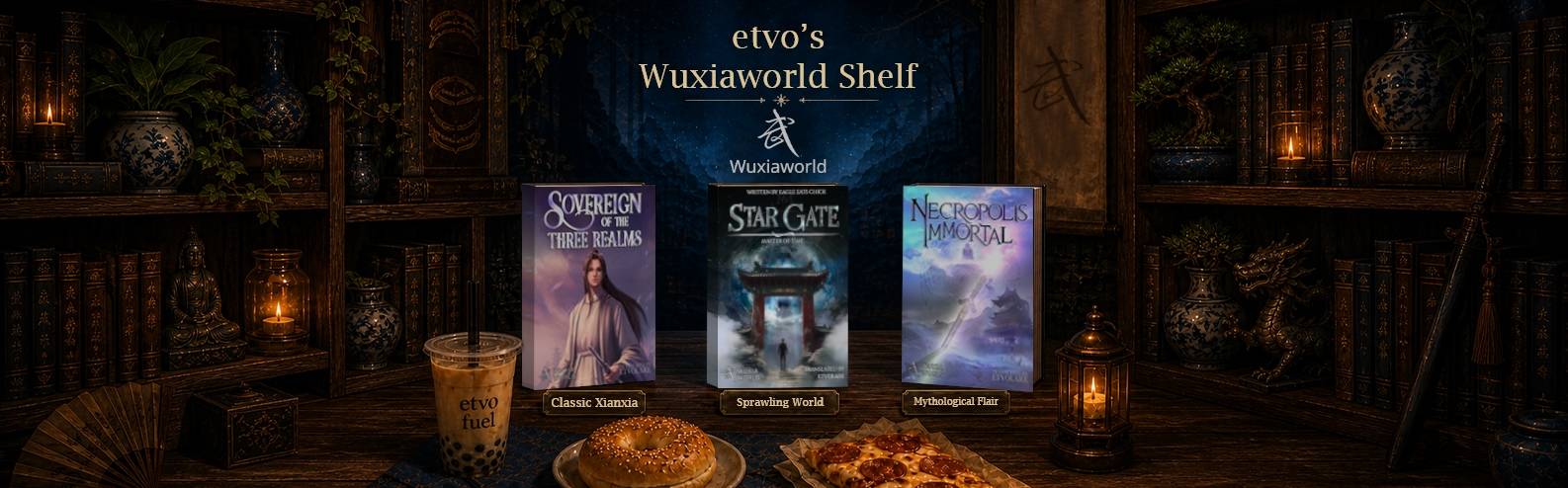
So if this spotlight made you curious, start reading or revisit etvo’s works currently available on Wuxiaworld.
Sovereign of the Three Realms: Classic long-form xianxia
Star Gate: Martial cultivation meets magic. Old is new and society needs to decide which is the top dog.
Necropolis Immortal: Dense cultivation systems, feng shui, Taoism, Buddhism, and mythological flair